

Seller financing carries two dominant risks: buyer credit and subordination exposure on seller notes, and post-closing manipulation or disputes on earnouts. Neither structure is inherently safe. Risk is managed through careful sizing, real buyer qualification, and covenants drafted with the same rigor a bank would demand. If you need guaranteed retirement liquidity, favor a smaller, well-secured note or push harder for cash at close.
TL;DR:
- Seller notes rely heavily on buyer creditworthiness, subordination terms, and contractual protections, making risk management critical through careful structuring.
- Earnouts are vulnerable to post-closing manipulation, vague metric definitions, and require strong dispute resolution clauses to prevent disputes.
- The likelihood of full repayment diminishes if senior lender positions are weak or if the buyer's leverage and interest-only periods are excessive.
- Tax and timing issues with deferred payments can create unexpected capital gains and recapture obligations that must be coordinated before closing.
- Successful deal structuring demands thorough buyer qualification, clear covenant drafting, and aligning financing with your retirement and tax planning needs.
Table of Contents
- Snapshot: The Main Seller Financing Risks at a Glance
- Seller Notes vs. Earnouts: How the Risks Differ
- Contract Protections Every Seller Should Negotiate
- Financial Structure Risks and Lender Interactions
- Tax and Timing Traps in Deferred Payments
- Due Diligence and Buyer Qualification Checklist
- Deal Red Flags You Should Refuse or Renegotiate
- Premier72's Perspective: Balancing Deal Completion With Retirement Liquidity
- How Premier72 Helps You Structure a Safer Seller-Financed Deal
- Sources
- FAQ
Snapshot: The Main Seller Financing Risks at a Glance
Before you negotiate a single term, know what you're actually underwriting. When you finance part of your own sale, you take on a version of the risk a bank normally absorbs, without a bank's collateral tools or collections department.
The core exposures fall into a short list:
- Buyer default, subordination, and refinancing risk on seller notes, where your recovery depends on someone else's balance sheet.
- Earnout manipulation through accounting choices or operational changes made after you've lost control of the business.
- Structural risk from balloon payments, long interest-only periods, and payment blocks triggered by senior lender defaults.
- Legal vagueness in metric definitions and weak or absent dispute resolution language.
- Tax timing problems, including installment sale rules and hot-assets exposure.
- Opportunity cost from proceeds that sit uncollected for years instead of funding your retirement plan today.
A Kuhn Capital analysis of earnout outcomes found that a meaningful share of acquisitions fall short of the buyer's own projections, which directly threatens any payment tied to future performance.
Seller Notes vs. Earnouts: How the Risks Differ
Seller notes and earnouts solve different problems in a deal, and they fail in different ways.
- Seller notes function like private lending. You become a junior creditor. Whether you get repaid hinges on the buyer's credit quality, how much senior debt sits ahead of you, and what happens if the business underperforms. A seller note effectively puts you in a lender's seat, and the face amount tells you almost nothing about what you'll actually collect.
- Earnouts tie payment to future performance you no longer control. The buyer runs the business after closing, and earnouts appeared in roughly a quarter of middle-market deals in recent years, a structure that generates disputes with striking regularity.
- Sellers pick notes when they want predictable, amortizing payments, and earnouts when a valuation gap needs bridging with upside tied to growth the seller believes in.
- Hybrid structures compound risk. A note plus an earnout plus a rollover equity stake means three separate failure points, each requiring its own protections rather than a single boilerplate clause.
Contract Protections Every Seller Should Negotiate
The gap between a seller note that pays out and one that doesn't almost always traces back to contract language written months before anyone expected trouble.
Start with definitions. "EBITDA" and "operate consistent with past practice" sound precise until a dispute forces you to prove what they mean. Fox Swibel's guidance on middle-market earnouts recommends attaching numeric examples and full accounting exhibits to the purchase agreement, not just a defined term.
Beyond definitions, negotiate for:
- Operational covenants with numerical baselines: minimum staffing levels, marketing spend floors, and explicit bans on diverting customers to a related entity.
- Monthly or quarterly reporting with real audit rights, not a year-end summary delivered after the earnout period closes.
- Economic floors, escrow holdbacks, and personal or parent-company guarantees when the buyer's own capital is thin.
- Prepayment triggers on refinance or change of control, so a sale of the business doesn't leave your note stranded.
- A defined dispute resolution path, including expedited accounting review or arbitration with a firm deadline, rather than open-ended litigation.
Pro Tip: Ask your attorney to walk through a hypothetical dispute using your actual draft language, line by line, before you sign. If the answer to "who wins this argument" isn't obvious from the contract alone, the clause needs rewriting.
Financial Structure Risks and Lender Interactions
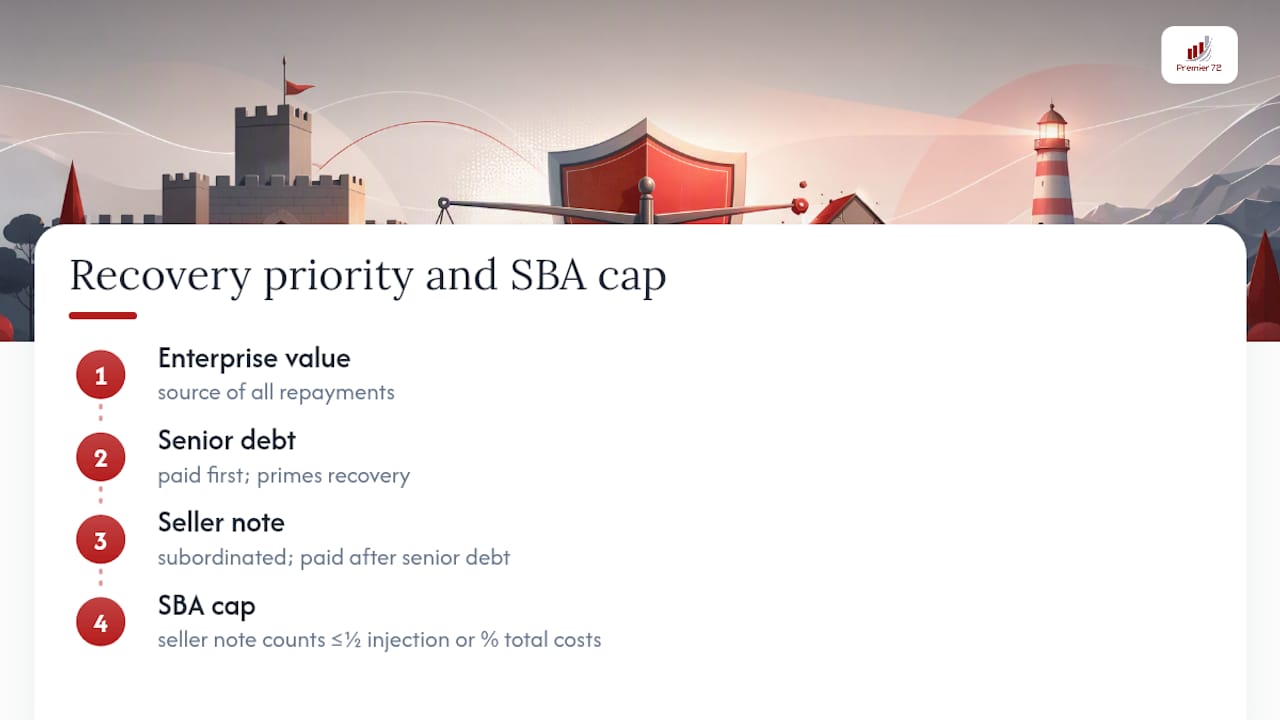
Your seller note doesn't exist in isolation. It sits behind the buyer's senior lender, and that position determines almost everything about your actual recovery odds.
If enterprise value drops after closing, senior debt gets paid first. A seller note subordinated behind an aggressive senior facility can leave you with little to nothing, regardless of what the note says on paper. Watch for red flags: thin buyer equity, leverage stacked well beyond what the business's cash flow supports, and long interest only or balloon periods that push all the real repayment risk to a single future date.
If the buyer is financing part of the deal through the Small Business Administration, there's a hard constraint worth knowing upfront. SBA rules cap the seller note that can count toward the required equity injection at up to half of that injection or a small percentage of total project costs, whichever applies. That limit shapes how much you can realistically defer if the buyer needs SBA financing to close at all, and it's worth reviewing alongside SBA assignment of beneficial interest rules before you finalize deal structure. Where possible, negotiate limited subordination or require senior lender consent to any payment block, so the block isn't indefinite.
Tax and Timing Traps in Deferred Payments
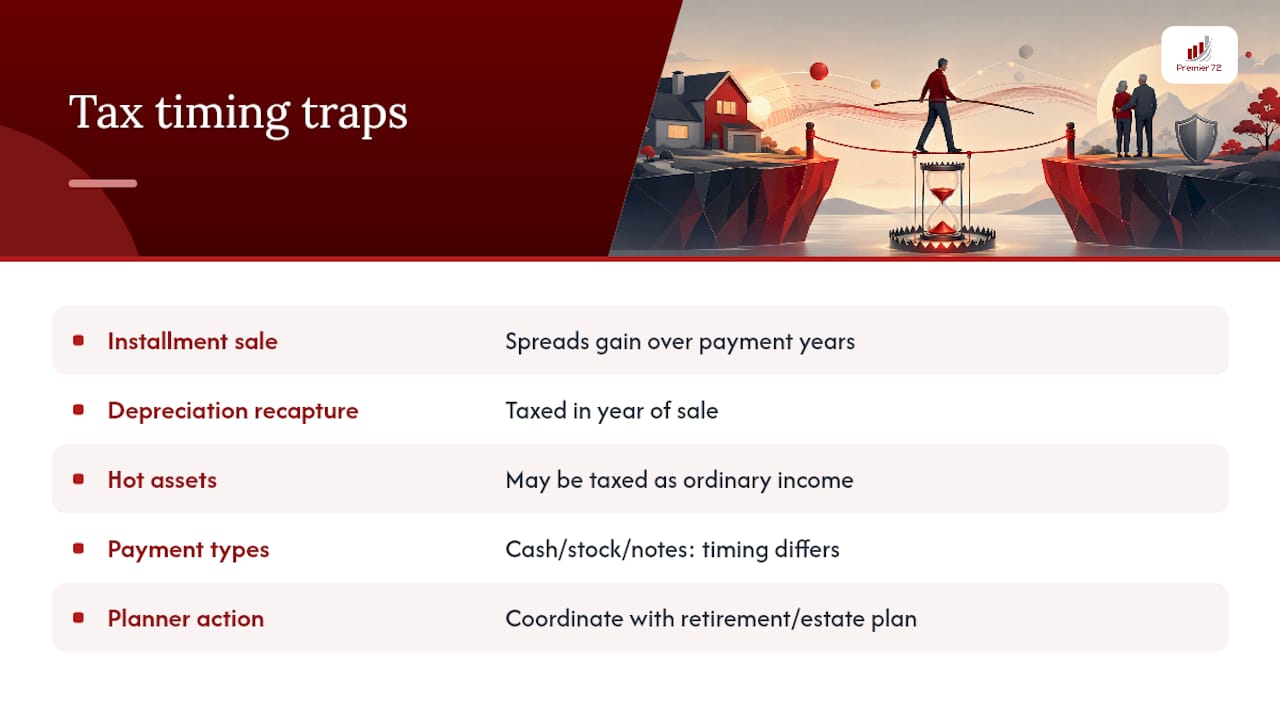
Deferred payments don't just create collection risk. They create tax complexity that catches sellers off guard almost every year.
Installment sale treatment lets you spread capital gains recognition across the years you actually receive payment, but it doesn't apply cleanly to every asset. Depreciation recapture on equipment and real property is typically taxed in the year of sale regardless of when cash arrives, and "hot assets" in an asset sale can trigger ordinary income treatment you didn't budget for. Cash, buyer stock, and promissory notes each carry different tax timing, which is exactly the kind of detail worth reviewing in Premier72's guide to installment sale recapture risk and its companion piece on capital gains exposure in a business sale. Coordinate the structure with your retirement and estate plan before you sign, not after.
Due Diligence and Buyer Qualification Checklist
Financing the buyer means underwriting them, and most sellers skip steps a bank never would.
- Pull real financial statements and lender term sheets. Confirm the buyer's equity contribution is actually funded, not projected.
- Require guaranties, escrow, or pledged collateral whenever the buyer's own capital looks thin relative to the purchase price.
- Verify management experience. A buyer who has never run a business like yours introduces execution risk that shows up in your earnout numbers or your note's repayment schedule.
- Stress-test repayment under a downside scenario. Model what happens to your note or earnout if revenue drops 20% in year one, and confirm your reporting rights let you catch problems early.
An advisory firm like Byram Advisory Group publishes useful background on buy-side diligence patterns worth reviewing before you finalize buyer requirements.
Deal Red Flags You Should Refuse or Renegotiate
Some terms aren't worth negotiating around. They're worth walking away from.
- A buyer asking you to fund a large share of the purchase price, especially paired with minimal buyer equity, is often a sign the deal can't get financed any other way.
- No personal or entity guarantee when the buyer's capital contribution is small.
- Payment blocks with no cure period or time limit, effectively letting a senior lender default freeze your note indefinitely.
- Earnout metrics defined vaguely or structured as all-or-nothing triggers instead of tiered, partial payments.
- Refusal to include acceleration on change of control or mandatory prepayment if the buyer refinances.
Premier72's Perspective: Balancing Deal Completion With Retirement Liquidity
Seller financing can be the difference between closing a deal and losing a qualified buyer. But sized wrong, it quietly converts your retirement into an unsecured loan to a stranger. The Retirement Bank Method™ exists because deal structure and retirement readiness have to be planned together, not sequentially. Coordinate financing terms, tax strategy, and liquidity needs before you sign the letter of intent, not after.
— Asa
How Premier72 Helps You Structure a Safer Seller-Financed Deal
Premier72 gives owners a structured alternative to negotiating seller financing alone, against buyers and their attorneys who negotiate deals for a living. An exit readiness assessment identifies how much deferred payment your retirement plan can actually absorb before you set a number. From there, Premier72 works through deal structuring, buyer qualification review, tax coordination, and the specific protection clauses, covenants, escrow terms, and guarantee language, that keep a seller note or earnout enforceable instead of theoretical.

The outcome is a deal with clearer reporting rights, negotiated covenants that hold up under dispute, and a financing structure built around an actual retirement timeline rather than the buyer's preferred terms. If you're preparing to sell and considering offering financing, start with Premier72's exit readiness services to review your deal structure before you sign anything.
This article is general information, not a substitute for advice from a qualified financial advisor. Consult a qualified financial professional about your own circumstances before acting on anything here.
Sources
- Earn-Out Provisions in Middle-Market M&A Transactions: A Seller’s Guide to Risk Mitigation - Fox Swibel
- Earnouts in M&A: When They Work, When They Don't, and How to Structure Them So Both Sides Win - AEGIS LAW
- Seller Notes in M&A: Meaning, Terms & Examples | Auxo
FAQ
Is Seller Financing Actually Safe for the Seller?
It can be, but safety depends on sizing the deferred amount conservatively, qualifying the buyer's credit and capital, and drafting covenants that survive a dispute, not on the instrument itself.
What's Riskier, a Seller Note or an Earnout?
They carry different risks: seller notes expose you to buyer credit and subordination risk, while earnouts expose you to post-closing manipulation because the buyer controls operations after the sale.
Do SBA Rules Limit How Much I Can Finance?
Yes. When a buyer uses SBA financing, the seller note counted as equity is capped at 50% of the required equity injection or 5% of total project costs, whichever applies.
What Contract Terms Reduce Earnout Disputes?
Precise, numeric metric definitions, detailed accounting exhibits, operational covenants, and a defined arbitration or expedited accounting review process all reduce the odds of a protracted earnout dispute.