

A split-dollar life insurance plan is a contractual agreement between two parties to share the costs, ownership, and benefits of a permanent life insurance policy. The two parties are typically an employer and a key employee, or two business partners. The policy itself is not a distinct insurance product. It is a financing and ownership strategy built on top of whole life or universal life insurance. For business owners and financial planners, this distinction matters because the structure you choose determines your tax exposure, your control over the policy, and how benefits flow at death or plan termination.
What is a split-dollar life insurance plan and how is it structured?
Split-dollar life insurance is defined as a shared-ownership arrangement, not a standalone policy type. The IRS recognizes two primary structural methods: the endorsement method and the collateral assignment method. Choosing between these two methods is one of the most consequential tax-planning decisions in executive compensation design.

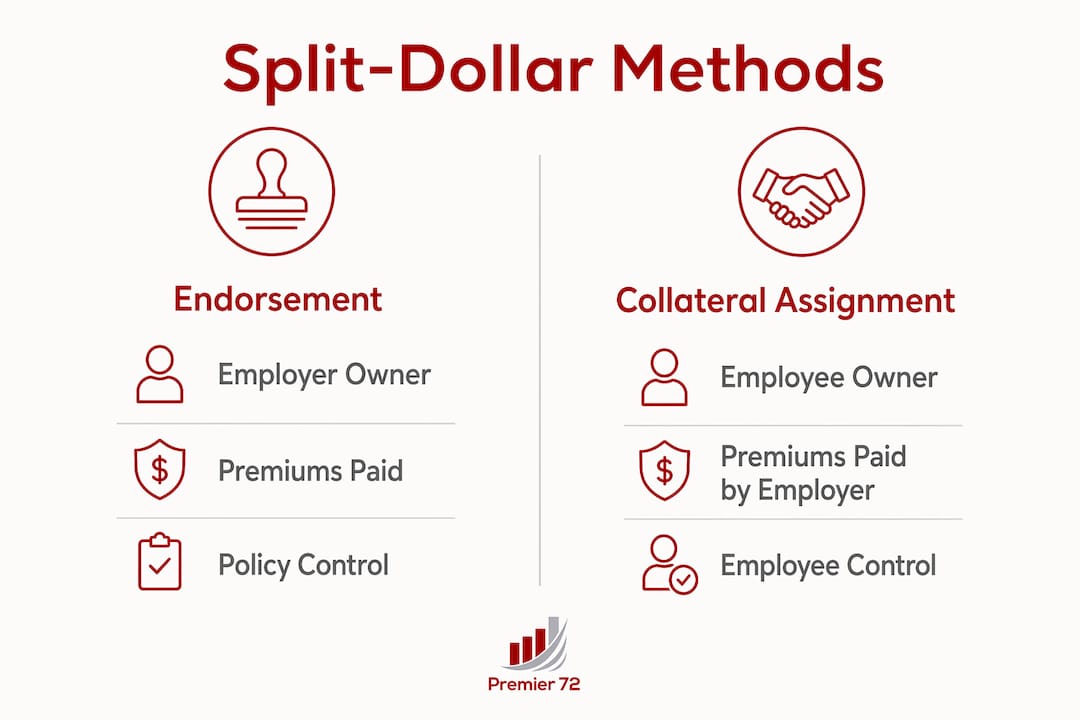
Endorsement method
Under the endorsement method, the employer owns the policy outright. The employer pays premiums and controls the cash value. The employer then endorses, or formally assigns, a portion of the death benefit to the employee or the employee's named beneficiary. The employee receives life insurance coverage without owning the policy. This structure gives the employer maximum control and simplifies premium recovery at plan termination.
Collateral assignment method
Under the collateral assignment method, the employee owns the policy. The employer pays some or all of the premiums, and the employee assigns the policy to the employer as collateral to secure those premium advances. The employer holds a security interest equal to the premiums paid. The employee retains the remaining cash value and death benefit above that amount. This method gives the employee more ownership rights but creates loan-like obligations that require careful structuring.
| Feature | Endorsement method | Collateral assignment method |
|---|---|---|
| Policy owner | Employer | Employee |
| Premium payer | Employer | Employer (treated as loan) |
| Cash value control | Employer | Employee |
| Death benefit split | Employer endorses share to employee | Employee assigns employer's share as collateral |
| Repayment obligation | None for employee | Employee's estate repays employer's advances |
Pro Tip: Before selecting a method, map out the exit scenario first. If the employee may leave before retirement, the endorsement method gives the employer cleaner recovery rights and fewer legal disputes over cash value.
What are the tax implications of a split-dollar life insurance plan?
The tax treatment of split-dollar arrangements is governed primarily by IRS Notice 2002-8, which established two distinct tax regimes: the economic benefit regime and the loan regime. The regime that applies depends on who owns the policy.
Under the economic benefit regime, the employer owns the policy (endorsement method). The employee receives a taxable economic benefit each year equal to the value of the life insurance protection provided. The IRS publishes Table 2001 rates to value this benefit. Failure to use the correct IRS valuation tables triggers tax liabilities for the employee, often retroactively.
Under the loan regime, the employee owns the policy (collateral assignment method). Each premium payment by the employer is treated as a separate loan to the employee. Those loans must carry interest at or above the IRS Applicable Federal Rate (AFR). If the interest rate falls below the AFR, the IRS imputes additional taxable income to the employee. That imputed interest increases the employee's tax burden without any corresponding cash payment.
Equity versus non-equity arrangements add another layer of complexity. In a non-equity arrangement, the employer recovers only the premiums paid, and the employee receives no cash value benefit. In an equity arrangement, the employee participates in cash value growth above the employer's recovery amount. Equity and non-equity arrangements carry fundamentally different tax treatments, particularly regarding how cash value growth is taxed during the life of the plan.
Split-dollar plans are exempt from ERISA rules, which gives employers flexibility in designing arrangements tailored to individual executives. That flexibility, however, does not reduce IRS scrutiny. Strict documentation and annual reporting remain non-negotiable.
Key IRS compliance points for split-dollar plans:
- Use IRS Table 2001 rates annually to value the economic benefit in endorsement arrangements.
- Apply the correct AFR to all employer premium advances in collateral assignment arrangements.
- Document each premium payment as a separate loan transaction with a written promissory note.
- Report the economic benefit or imputed interest on the employee's W-2 each year.
- Maintain a written split-dollar agreement that specifies ownership, premium obligations, and termination terms.
Pro Tip: Engage a tax attorney or CPA with split-dollar experience before the plan launches, not after the first tax year. Retroactive corrections under IRS Notice 2002-8 are possible but costly and time-consuming.
What are the benefits of split-dollar life insurance for business owners?
Split-dollar plans reduce the employee's cost of obtaining permanent life insurance coverage, which is the most immediate and visible benefit. The employer absorbs most or all of the premium, making high-value whole life or universal life coverage accessible to key executives who might not otherwise purchase it independently.
For business owners, the strategic value runs deeper than cost sharing. Employers gain the ability to select plan participants, which makes split-dollar arrangements a targeted retention tool for key executives. The employer also recovers premiums from the death benefit or cash value when the plan terminates, which means the cost of the benefit is ultimately recoverable. That cost recovery feature separates split-dollar plans from straightforward executive bonuses, where the employer's outlay is permanent.
Split-dollar arrangements also support wealth transfer and succession planning. Private split-dollar plans paired with irrevocable life insurance trusts (ILITs) keep death benefits outside the taxable estate, reducing estate tax exposure for high-net-worth business owners. The ILIT owns the policy, the employer funds the premiums through the split-dollar agreement, and the death benefit passes to heirs free of estate tax. This structure is one of the most tax-efficient wealth transfer mechanisms available to business owners with illiquid estates, such as those holding closely held business interests.
Top benefits for business owners and financial planners:
- Premium cost sharing reduces the employer's net outlay because premiums are recoverable at plan termination or death.
- Selective participation lets employers target key executives without offering the benefit to all employees.
- Executive retention ties valuable employees to the company through a long-term benefit with real financial weight.
- Estate planning integration with ILITs removes death benefits from the taxable estate.
- Succession planning support provides liquidity and coverage that can fund buy-sell agreements or key person replacement costs.
- Flexibility in plan design, since ERISA exemption allows customized terms for each participant.
For a broader view of how life insurance fits into business legacy planning, split-dollar arrangements are one of several structures worth evaluating alongside executive bonus plans and key person coverage.
What challenges and best practices apply to split-dollar plan management?
Valuation disputes are the most common source of conflict in split-dollar arrangements. When the employer and employee disagree on the cash value attributable to each party, plan termination becomes contentious. A clearly written agreement, drafted before the policy is issued, eliminates most of these disputes by defining the recovery formula in advance.
Employee termination is the second major risk. If a key executive leaves before the plan matures, the employer must recover its premium advances from the policy's cash value or death benefit. Clear written agreements that define termination triggers, recovery timelines, and ownership transfer rights protect both parties. Without these provisions, the employer may face delays or legal costs in recovering its investment.
Annual reviews are not optional. IRS compliance in split-dollar arrangements requires updated economic benefit calculations, correct AFR application, and accurate W-2 reporting every year. A plan that was compliant at launch can drift out of compliance as interest rates change or policy values shift.
Best practices for split-dollar plan administration:
- Draft a formal split-dollar agreement before the policy is issued, covering ownership, premiums, benefit splits, and termination.
- Review the agreement annually with legal and tax counsel to reflect IRS rate changes and policy performance.
- Maintain a separate promissory note for each employer premium advance in collateral assignment arrangements.
- Coordinate with the life insurance carrier to confirm that policy illustrations align with the agreement's benefit-sharing formula.
- Document all plan changes in writing and obtain signatures from both parties.
Business owners who rely on life insurance for succession and continuity planning should treat the split-dollar agreement as a living document, not a one-time filing.
Key Takeaways
A split-dollar life insurance plan works only when the ownership structure, tax regime, and written agreement are aligned from the start.
| Point | Details |
|---|---|
| Core definition | A split-dollar plan is a cost-sharing agreement on a permanent life insurance policy, not a separate product. |
| Two ownership methods | Endorsement gives the employer control; collateral assignment gives the employee ownership with loan obligations. |
| IRS compliance is mandatory | IRS Notice 2002-8 governs valuation; errors trigger taxable income for the employee. |
| Estate planning integration | Pairing with an ILIT removes death benefits from the taxable estate for high-net-worth owners. |
| Written agreements prevent disputes | Clear termination and recovery terms in the agreement protect both the employer and the employee. |
Why split-dollar plans deserve more attention than they get
Most business owners I work with have heard of split-dollar life insurance but treat it as an obscure executive compensation tool reserved for Fortune 500 companies. That perception is wrong, and it costs closely held business owners real money.
A well-structured split-dollar arrangement is one of the few planning tools that simultaneously solves three problems: it provides meaningful life insurance coverage to a key executive, it keeps the employer's premium outlay recoverable, and it creates a tax-efficient path for wealth transfer. No other single structure does all three at once.
The mistake I see most often is treating the split-dollar agreement as a formality. Business owners sign the agreement at policy issue and file it away. Then five years later, an executive leaves, or the IRS audits the W-2 reporting, and the documentation is incomplete. The cost of that oversight is almost always higher than the cost of proper annual maintenance would have been.
My recommendation is direct: if you are using a split-dollar arrangement, review it every year with a tax attorney and your financial advisor. If you are considering one, start with the endorsement method unless you have a specific reason to give the employee policy ownership. The endorsement method is cleaner to administer and easier to unwind. For business owners integrating executive compensation strategies with succession planning, split-dollar deserves a serious look before you default to simpler but less efficient alternatives.
— Asa
How Premier72 helps you structure split-dollar life insurance plans
Split-dollar life insurance plans require precise coordination between legal agreements, tax compliance, and long-term succession goals. Premier72 works with established business owners and financial planners to design insurance-based strategies that protect income, preserve wealth, and support a clean exit.

Whether you need to structure a split-dollar arrangement for a key executive, integrate life insurance into a buy-sell agreement, or build a legacy plan that reduces estate tax exposure, Premier72 brings the advisory depth to get it right. The Retirement Bank Method™ positions your business as a transferable asset, and structured life insurance is a core part of that foundation. Connect with Premier72's advisory team to build a plan that fits your business, your executives, and your exit timeline.
FAQ
What is a split-dollar life insurance plan in simple terms?
A split-dollar life insurance plan is a formal agreement where two parties, typically an employer and employee, share the premiums, ownership, and benefits of a permanent life insurance policy. It is a financing strategy, not a separate type of insurance product.
What is the difference between endorsement and collateral assignment?
In the endorsement method, the employer owns the policy and assigns part of the death benefit to the employee. In the collateral assignment method, the employee owns the policy and assigns the employer's premium advances back as collateral.
What are the tax implications of a split-dollar agreement?
Tax treatment depends on the ownership structure. Endorsement arrangements follow the economic benefit regime under IRS Notice 2002-8, while collateral assignment arrangements follow the loan regime, requiring interest at or above the IRS Applicable Federal Rate.
Who needs split-dollar life insurance?
Split-dollar plans work best for business owners who want to provide permanent life insurance to key executives, recover premium costs, and integrate life insurance into estate or succession planning without a permanent cash outlay.
Can a split-dollar plan be used for estate planning?
Yes. Pairing a split-dollar arrangement with an irrevocable life insurance trust keeps death benefits outside the taxable estate, making it one of the most tax-efficient wealth transfer tools available to high-net-worth business owners.