

A phantom stock plan is a promise to pay cash equal to the value of company stock, without giving the recipient actual shares. No equity moves, no voting rights change hands, and your cap table stays exactly as it was. The employee benefits when the company grows in value; you keep full control of ownership.
That trade-off is the whole story in one sentence: you avoid dilution, but you take on a future cash obligation instead. For an S-corp that cannot issue a second class of stock, or an LLC founder who does not want a former key employee on the ownership ledger, phantom equity often solves the retention problem that real equity would create. J.P. Morgan's analysis of phantom equity frames it as a way to deliver equity-like upside to private-company employees while sidestepping the administrative friction of adding shareholders.
The catch is that a phantom stock plan is a liability you're creating today that comes due later, often at the worst possible moment, like a sale or a leadership transition. Get the design wrong and you can also trigger a Section 409A violation that taxes your employee immediately and penalizes them for a benefit they haven't even received in cash.
Here's what actually matters when you build one:
- Structure: full-value units or appreciation-only units (SARs), each with different tax and accounting effects
- Compliance: Section 409A governs timing, valuation, and payout triggers
- Funding: sinking funds, escrow, or corporate-owned life insurance to cover the obligation when it comes due
- Documentation: a plan document with precise definitions, vesting terms, and trigger language
Key Takeaways
A phantom stock plan retains key employees with cash tied to company value while avoiding equity dilution, but it only works long term if you fund the liability and document it under Section 409A from day one.
| Point | Details |
|---|---|
| Choose your unit type early | Full-value units pay total share value; appreciation-only units (SARs) pay only the growth, costing less at every valuation point. |
| Document valuation methodology | Use an independent 409A valuation or a documented formula to set a defensible baseline and reduce IRS challenge risk. |
| Plan for the FICA mismatch | Payroll taxes can be due at vesting under IRC 3121(v)(2), before any cash reaches the employee. |
| Fund the liability early | Sinking funds, escrow, or COLI keep a future payout from straining cash at a sale or change in control. |
| Model liability against exit proceeds | Buyers deduct unfunded phantom obligations from purchase price, so Premier72 builds this into exit-readiness modeling from the start. |
Table of Contents
- What Is a Phantom Stock Plan and How Do the Units Work?
- Tax Treatment and Section 409A Compliance Rules You Cannot Ignore
- Building the Plan: A Design Sequence That Holds Up to Scrutiny
- Funding the Plan So a Payout Doesn't Drain Your Business
- How Phantom Stock Hits Your Balance Sheet and P&L
- Documenting the Plan: The Checklist Your Attorney Will Actually Need
- Exit-Readiness Planning: Aligning Phantom Stock With Your Eventual Sale
- Legal Risk Beyond Taxes: ERISA and Securities Law Exposure
- What Phantom Stock Looks Like in Practice
- When Phantom Stock Makes Sense (And When It Doesn't)
- Where to Verify These Rules and Find Model Plan Language
- How Premier72 Helps You Fund and Protect a Phantom Stock Commitment
- Frequently Asked Questions About Phantom Stock Plans
- Sources
What Is a Phantom Stock Plan and How Do the Units Work?
A phantom stock unit is a bookkeeping entry, not a security. It tracks the value of one share of company stock (or the growth in that value) and pays out in cash on a defined event. Sample plan language filed with the SEC describes phantom stock as "a contractual right to receive cash equal to the fair market value of a share" on a specified settlement date, and that framing matters. It's a contract, not equity, which is why phantom stock plans generally sit outside securities law registration requirements that would apply to actual stock grants, per SunTrust Banks' SEC-filed phantom stock plan.
There are two structural flavors, and the choice shapes everything downstream.
- Full-value phantom stock pays the entire value of a share at settlement. If the company is worth $10,000 per hypothetical share when granted and $18,000 when the unit pays out, the employee receives $18,000 per unit. This mirrors restricted stock and delivers a bigger, simpler incentive.
- Appreciation-only units, often called phantom stock options or synthetic SARs, pay only the increase in value between grant and payout. Using the same numbers, the employee would collect $8,000, the growth, not the base value. This mirrors a stock option and costs the company less at every valuation level.
The lifecycle runs through four checkpoints: grant, vesting, a valuation event, and settlement. At grant, you assign a number of phantom units and set the baseline value against which future appreciation is measured. At vesting, the employee earns a nonforfeitable right to the units, usually tied to time served or performance milestones, but vesting alone does not trigger payment. The valuation point, typically the vesting date, a change-in-control, or a fixed anniversary, determines what the units are worth when the obligation crystallizes. Settlement is when cash actually changes hands, and that's where your payroll and tax obligations kick in.
Withholding responsibility at payout looks like any other compensation event: federal and state income tax withholding, plus FICA, applies at settlement (with a wrinkle covered in the next section). Most companies run phantom stock through a simple unit ledger, similar to a cap table but entirely internal, tracking each participant's grant date, vesting schedule, unit count, and running value. You don't need specialized equity management software to administer this well, though larger plans with dozens of participants often benefit from one.
Pro Tip: Decide between full-value and appreciation-only units before you set the valuation methodology, not after. Appreciation-only plans require a defensible baseline value at grant, since the entire payout calculation depends on measuring growth from that number.
Tax Treatment and Section 409A Compliance Rules You Cannot Ignore
Phantom stock plans are nonqualified deferred compensation, and the tax mechanics follow a clean rule: no tax at grant, no tax at vesting, ordinary income tax only when cash actually pays out. That deferral is part of the appeal, employees don't owe anything on paper gains, but it also means the entire plan lives under Section 409A of the Internal Revenue Code, one of the least forgiving corners of the tax code for a design mistake.
Section 409A dictates when compensation can be paid, and it does not let you improvise. Payouts must be tied to one of a short list of permitted triggering events: a fixed date, separation from service, death, disability, an unforeseeable emergency, or a change in control. You cannot let an employee choose to accelerate payment, and you generally cannot let the company unilaterally delay it either. Deviate from the plan's stated terms in either direction and you risk blowing the whole arrangement.
The penalty for getting this wrong is severe enough to destroy the plan's purpose entirely. A 409A failure triggers immediate taxation on all vested amounts, whether or not cash has been paid, plus a 20% federal penalty tax on top of ordinary income tax, plus interest charges. LegalClarity's breakdown of phantom stock taxation confirms this exposure applies to the employee, not just the company, which means a drafting error can financially punish the very person you were trying to retain.
409A penalty at a glance: A violation means immediate income recognition on vested phantom stock value, a 20% additional tax, and accrued interest, applied to the employee even though no cash has actually been received.
One narrow exception matters for smaller or newer plans: the short-term deferral rule. If payment happens within two and a half months after the end of the tax year in which the amount vests, the arrangement can fall outside 409A's more restrictive requirements entirely. Fast-vesting, fast-paying plans sometimes qualify; multi-year deferred plans almost never do.
FICA taxes complicate this further. Under IRC Section 3121(v)(2), payroll taxes on phantom stock can become due at vesting, not at payout, if the amount is reasonably ascertainable at that point. That creates a genuine cash-flow mismatch: an employee's phantom units vest, triggering a payroll tax obligation, but no cash has actually landed in their pocket. RSM US's analysis of common phantom stock questions flags this as one of the most frequently misunderstood aspects of these plans, and it's a real planning problem, not a technicality: someone has to cover that payroll tax bill, and it's often the employee out of pocket unless the employer builds in a mechanism to advance it.
On the employer side, the deduction generally follows the income. You deduct the payout as compensation expense in the year the employee recognizes ordinary income, which is the payout year, not the grant or vesting year. Large payouts to highly compensated executives can also run into the $1 million deduction cap under Section 162(m) for public companies, though most private companies using phantom stock fall outside that rule's reach.
- No taxable event at grant or vesting for the employee
- Ordinary income tax due at settlement, taxed like a cash bonus
- FICA can be due earlier, at vesting, creating a cash-tax mismatch
- 409A violations mean immediate taxation plus a 20% penalty, applied to the employee
- Employer deduction timing tracks the employee's income recognition, generally at payout
Building the Plan: A Design Sequence That Holds Up to Scrutiny
Design order matters more than most owners assume. Get the sequence backward, deciding payout terms before you've settled on valuation methodology, for instance, and you end up rewriting the document twice. Here's the order that keeps you out of trouble.
- Define eligibility and grant cadence. Decide whether phantom stock goes to a handful of C-suite executives or a broader group of key managers, and whether you'll issue one-time grants or rolling annual grants. Rolling grants create an ongoing retention hook, since an employee who leaves forfeits unvested future grants, not just the current one.
- Choose full-value or appreciation-only units. Full-value units deliver a bigger, easier-to-explain incentive but cost you more at every valuation point. Appreciation-only units cost less and mirror how employees already think about stock options, which can make them easier to communicate to a technically sophisticated team.
- Lock in your valuation method and document it in the plan. You have three real choices: a mechanical formula (a multiple of EBITDA or book value, for example), an independent third-party 409A valuation, or board determination based on a documented process. Carta's guide to phantom equity makes the case that a defensible, independent 409A valuation is the safest baseline, particularly for appreciation-only plans where the entire payout hinges on measuring growth from an accurate starting point. A formula is cheaper and faster but invites IRS scrutiny if it doesn't reflect real market value. Board determination without outside support is the riskiest option and the one most likely to unravel under audit.
- Set the vesting schedule. Cliff vesting (nothing until a set date, then 100%) is simple but can feel like a cliff to the employee, literally nothing, then everything. Graded vesting (a percentage each year over three to five years) smooths the incentive and reduces flight risk in years two or three. Performance-based vesting ties payout to revenue, EBITDA, or other metrics you can measure and defend.
- Decide single-trigger vs. double-trigger for change-in-control. A single trigger pays out automatically the moment a sale closes. A double trigger requires both a change in control and the employee's termination (or a material role change) before payment. Double triggers are more common in practice because they protect against employees quitting the day after a sale purely to cash out.
- Set the payout form. Lump sum is simplest and most employee-friendly. Installment payments over two to five years reduce the cash-flow hit to the company but usually require you to specify whether unpaid balances accrue interest, and at what rate. Some plans cap the maximum payout per unit to control worst-case liability.
- Draft trigger and definition language with 409A in mind. Vague terms like "upon a liquidity event" invite disputes and 409A risk. Define exactly what counts as a change in control, exactly when "termination" is measured, and exactly how many days after a triggering event payment must occur.
The single biggest design mistake owners make is treating valuation as a formality to settle later. Set it first, document the methodology in the plan itself, and every other decision, vesting, triggers, payout caps, gets easier because you're working from a defensible number instead of a guess.
Funding the Plan So a Payout Doesn't Drain Your Business
The most common failure mode with phantom stock has nothing to do with taxes or drafting. It's simpler and more dangerous: the company grows exactly as intended, the phantom units appreciate exactly as intended, and then a change-in-control event hits and the business doesn't have the cash to cover multiple payouts at once.
Three funding approaches address this, each with real trade-offs.
- Sinking funds and reserves: You set aside a percentage of profit each year into a dedicated account, building liquidity on a predictable schedule. This is the simplest approach and requires no underwriting, but it ties up working capital that might otherwise fund growth, and it earns whatever your reserve account earns, which usually isn't much.
- Escrow arrangements: Funds are held by a third party and released only against defined triggering events. This adds a layer of assurance for employees, who can see the money is set aside, but it locks up capital just as reserves do, often with added administrative fees.
- Corporate-owned life insurance (COLI): The company purchases a policy on a key executive's life, and the cash value can accumulate to offset the projected phantom liability over time. Schiff Benefits' setup guide for phantom stock plans lists COLI alongside sinking funds as a standard institutional response to this exact funding gap. The advantage is that policy cash value grows tax-deferred and the death benefit can provide liquidity precisely when a key person's departure (through death) would otherwise trigger a payout. The trade-off is underwriting requirements, ongoing premium cost, and the fact that cash value accumulation takes years to reach meaningful scale, so this works best when you start early relative to your grant timeline.
Whichever route you choose, model the liability the same way a buyer eventually will. When you sell the business, a sophisticated buyer does not ignore unfunded phantom stock obligations, they deduct the present value of that liability directly from the purchase price, the same way they'd account for outstanding debt. An unfunded phantom stock plan can quietly erode your exit proceeds by the exact amount you thought you were building.
Pro Tip: Start funding within the first one to two years after your first meaningful grant, not when the liability has already grown large. A sinking fund contribution equal to a fixed percentage of the projected liability's annual growth is far easier to absorb than a lump-sum catch-up five years in.
Timing benchmarks vary by company size and growth rate, but the principle holds across the board: funding should track grant issuance, not lag behind it by years. If you're issuing new phantom grants annually but haven't touched your funding reserve in three years, that gap is exactly where an exit-derailing surprise comes from. Our guide on funding a buy-sell agreement with life insurance walks through similar insurance-backed funding mechanics that apply directly to phantom liabilities.
How Phantom Stock Hits Your Balance Sheet and P&L
Phantom stock is a liability, not equity, and your accountant needs to treat it that way from day one. Under ASC 718, phantom stock awards are classified as liability awards and remeasured at fair value at the end of every reporting period, not just at grant. Meissner Tierney Fisher & Nichols' primer on phantom stock accounting describes this mark-to-market treatment as one of the defining accounting differences between phantom stock and real equity awards, which are typically measured once at grant and expensed over the vesting period without ongoing remeasurement.
That distinction has real consequences for your financial statements. As the company's value climbs, so does the phantom stock liability, and each remeasurement flows through as compensation expense on your income statement. A business having a strong year can show a corresponding spike in comp expense purely because phantom units appreciated in step with the good year, which can look like a problem to a lender reading the P&L without context.
- The liability appears on your balance sheet and grows with company value, not with cash paid out
- Comp expense fluctuates with valuation swings, which can compress reported EBITDA in strong growth years
- Loan covenants tied to EBITDA or net income can be tripped by phantom stock remeasurement even when the underlying business is healthy
- The tax deduction timing (at payout) does not match the P&L expense timing (recognized as value accrues), so book and tax numbers diverge
Model your worst-case payout year before you sign off on plan terms, not after. Run a scenario where the business value jumps sharply and multiple participants hit a payout trigger in the same year, then check that scenario against your loan covenants and cash position. If that scenario would put you in covenant default or cash-strapped territory, redesign the vesting or payout caps before you grant a single unit, not after employees are counting on the number.
Documenting the Plan: The Checklist Your Attorney Will Actually Need
A phantom stock plan lives or dies by its paperwork. Vague plan language is the single most common source of 409A risk and employee disputes, and it's entirely avoidable with a thorough document. Every plan should include these elements, at minimum:
- Unit definition: what a phantom unit represents and how many are being granted to each participant
- Valuation formula or methodology: the exact method used to determine fair market value at each measurement date
- Vesting schedule: cliff, graded, or performance-based, with specific dates or metrics
- Payout triggers: the precise, exhaustive list of events that cause settlement
- Payment timing: the exact number of days after a trigger within which payment must occur
- Forfeiture provisions: what happens to unvested (and sometimes vested) units on voluntary resignation or termination for cause
- Treatment on death, disability, and termination: separate provisions for each scenario, since they often warrant different treatment
- Amendment rights: whether and how the company can modify the plan, and what protections existing participants retain
- Anti-dilution language: how phantom unit values adjust for stock splits, recapitalizations, or major corporate transactions, even though no real shares exist
SEC-filed phantom stock plan exhibits offer a useful reference point for how these clauses read in an enforceable, real-world document, though your own plan should be drafted for your specific facts, not copied wholesale.
"Phantom Stock" means a bookkeeping unit that entitles the Participant to a cash payment based on the value of a share of common stock of the Company, subject to the vesting and payment terms set forth herein.
That kind of precise, contractual phrasing, illustrative rather than a template you should copy verbatim, is the tone your actual plan document needs throughout: specific, unambiguous, and tied to defined terms rather than loose descriptions. Every grant should also come with a grant notice stating the participant's name, unit count, grant date, vesting schedule, and a reference to the full plan document. Keep signed grant notices, board approval minutes authorizing the plan and each grant, and your independent valuation reports in a permanent file. If you ever bring in outside investors, expect them to ask for all of it during diligence, since an undisclosed or poorly documented phantom liability is exactly the kind of surprise that slows down a deal.
Exit-Readiness Planning: Aligning Phantom Stock With Your Eventual Sale
Most owners design a phantom stock plan to solve today's retention problem and only think about the exit implications years later, usually when a buyer's diligence team starts asking pointed questions about unfunded liabilities. The Retirement Bank Method™ approach treats the phantom stock liability as a line item in exit modeling from day one, not an afterthought discovered during a sale process.
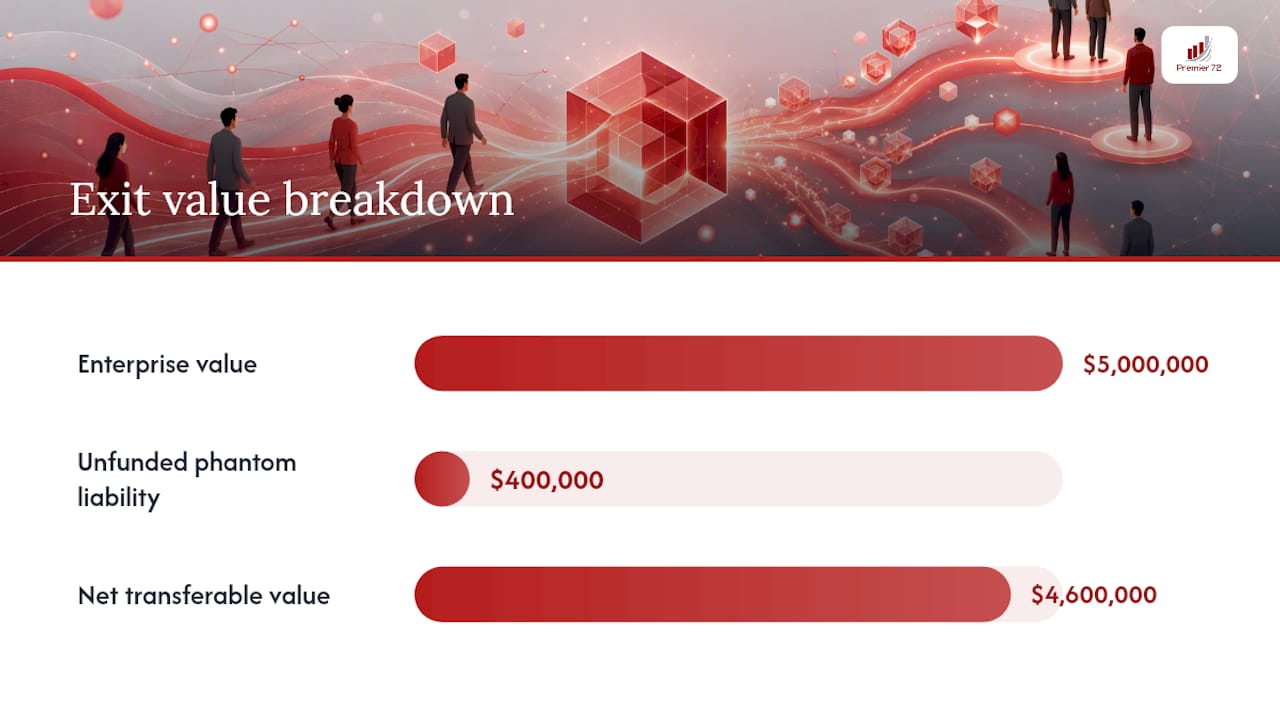
The reasoning is straightforward: a phantom stock liability directly reduces the net proceeds you'll actually walk away with. If your business is worth $5 million and you're carrying $400,000 in unfunded phantom stock obligations, your real transferable value is closer to $4.6 million, and a sophisticated buyer's offer will reflect that math whether or not you've modeled it yourself in advance.
Before granting phantom units, Premier72 recommends owners work through a short pre-grant checklist:
- Normalize owner salary first. If your compensation is understated or overstated relative to market rate, your baseline valuation, and therefore every phantom unit's value, will be distorted from day one. Our guide on normalizing owner salary before a sale covers why this step comes before any equity or phantom equity decision.
- Model sale proceeds net of the projected liability, not just gross enterprise value, so you know your real number before you grant a single unit.
- Choose a funding mechanism at design time, not after the liability has grown.
On that last point, the choice between insurance-backed funding and simple reserves usually comes down to time horizon and the value of a death-benefit backstop. Premier72 generally points owners toward COLI-backed funding when a key employee's unexpected death would otherwise force an immediate, unfunded payout, since the policy's death benefit solves that exact scenario. Reserve funding tends to fit better when the payout horizon is shorter and more predictable, such as a planned sale within three to five years.
Pro Tip: Run your exit model with and without the phantom liability side by side. If the gap between those two numbers surprises you, it will surprise a buyer too, and buyers price in surprises at a discount.
Legal Risk Beyond Taxes: ERISA and Securities Law Exposure
Tax compliance gets the most attention, but two other legal exposures deserve equal scrutiny. The first is ERISA. Most phantom stock plans limited to a select group of executives or highly compensated employees qualify as "top-hat" plans, which exempts them from ERISA's funding, vesting, and fiduciary requirements. That exemption is not automatic, though. Extend a phantom stock plan too broadly across your workforce, and you risk losing top-hat status and triggering full ERISA compliance obligations you never designed for, including minimum funding standards and fiduciary duties around the plan.
The second is securities law. Because phantom stock is a contractual cash right rather than a security, it generally avoids the registration and disclosure requirements that apply to stock option grants. That distinction depends on the plan being drafted correctly, though. A poorly worded plan that starts to resemble an actual equity interest, granting something like conversion rights or actual ownership features, can blur that line and invite exactly the securities compliance burden you were trying to avoid by choosing phantom stock in the first place.
Beyond these two areas, treat the plan document itself as a risk-management tool. Clear forfeiture language, well-defined triggering events, and documented board approval all reduce the odds of a dispute escalating into litigation. Given how much of this hinges on plan wording and eligible-participant scope, involve employment and securities counsel during drafting, not after a dispute arises.
What Phantom Stock Looks Like in Practice
A founder-led manufacturing company with two non-family executives running day-to-day operations offers a typical use case. The owner wants to retain both leaders through a planned sale in five to seven years but doesn't want to bring on minority shareholders before an exit. A phantom stock plan with graded vesting over five years and a double-trigger change-in-control provision solves both problems: each executive has a real financial stake in the sale price, and the owner keeps full ownership until the transaction closes.

A professional services firm structured as an S-corp illustrates a different scenario. S-corp shareholder limits and the single-class-of-stock rule make issuing real equity to key non-owner staff legally complicated. Appreciation-only phantom units sidestep that restriction entirely, since no actual stock class is created, while still giving senior staff meaningful upside tied to firm growth.
A common outcome pattern across both cases: plans that fund the liability early, through a sinking fund or COLI, tend to reach the payout event without disrupting operations. Plans that treat funding as a future problem more often force a scramble, sometimes a bridge loan or a delayed closing, when the triggering event actually arrives. The design decisions made in year one, particularly around valuation methodology and funding cadence, are what separate those two outcomes, not the payout amount itself.
When Phantom Stock Makes Sense (And When It Doesn't)
Phantom stock earns its place when you're running a private company, an S-corp, or an LLC that cannot easily issue real equity, and you need to retain two or three key people through a specific horizon, often a planned sale. It also fits well when you want a flexible, forfeitable incentive that disappears if someone leaves early, something profit-sharing plans generally can't replicate since they're often subject to broader qualified-plan rules.
Alternatives deserve serious consideration in other situations. An executive bonus plan funded with life insurance works better when you want simplicity and don't need the multi-year retention hook that vesting provides. A profit-sharing plan fits when you want to reward a broader group tied to annual performance rather than long-term equity value. An actual ESOP makes sense at meaningfully larger scale, when you're prepared for the trust structure and ongoing compliance it demands.
My honest read: don't design the incentive before you've modeled the liability. Talk to counsel about your specific entity structure, then build the funding path before you grant a single unit, not after.
Where to Verify These Rules and Find Model Plan Language
Legal drafting should always go through qualified counsel, but these sources are worth reviewing before that conversation so you walk in with informed questions.
- SunTrust Banks' phantom stock plan (SEC exhibit) for real-world plan definitions and distribution language
- A second SEC-filed phantom stock plan exhibit for comparison clauses on vesting and forfeiture
- RSM US's frequently asked questions on phantom stock for FICA timing and payroll tax mechanics
- Carta's founder's guide to phantom equity for valuation approaches and design considerations
- LegalClarity's guide to phantom stock taxation for a plain-language walkthrough of 409A penalty exposure
How Premier72 Helps You Fund and Protect a Phantom Stock Commitment
Designing the plan document is only half the job. The other half is making sure the company can actually pay when a triggering event arrives, without derailing an exit or straining operating cash in a strong year. Premier72 works with owners on exactly that gap: modeling what a phantom stock liability does to your projected sale proceeds, building a funding path using reserves or corporate-owned life insurance, and folding that liability into the broader exit-readiness picture through The Retirement Bank Method™.

If you've already granted phantom units, or you're weighing whether to, the smartest next step is running the liability against your real exit numbers before you sign off on plan terms. Schedule a consultation with Premier72 to model your funding path and see exactly how a phantom stock obligation affects what you'll actually walk away with at sale.
Frequently Asked Questions About Phantom Stock Plans
Is a phantom stock plan the same as real stock options? No. Stock options give the holder the right to purchase actual shares at a set price. Phantom stock pays cash tied to share value or appreciation, with no shares ever changing hands and no dilution to existing owners.
Do employees pay tax when phantom stock units vest? Generally no. Under standard nonqualified deferred compensation treatment, employees owe ordinary income tax at payout, not at vesting. FICA payroll tax can be due earlier, at vesting, which is a separate and often overlooked timing issue.
Can an S-corp or LLC offer phantom stock? Yes, and this is one of the main reasons private companies choose phantom stock over real equity. It delivers equity-like incentives without violating S-corp shareholder restrictions or complicating an LLC's ownership structure.
What happens to phantom stock if an employee is terminated? That depends entirely on the plan document. Most plans forfeit unvested units on termination and may also forfeit vested-but-unpaid amounts in cases of termination for cause, so the specific forfeiture language matters enormously.
How do you value phantom stock units? Common methods include an independent third-party 409A valuation, a documented formula such as a multiple of EBITDA, or board determination supported by a documented process. Independent valuations carry the least audit risk.
Does a phantom stock plan need to be funded in advance? It's not legally required, but unfunded plans create real financial risk. A sinking fund, escrow account, or corporate-owned life insurance policy keeps a payout obligation from straining cash flow when a triggering event arrives.
Sources
- Understanding Phantom Equity & Stock Plans for Startups (J.P. Morgan)
- SunTrust Banks, Inc. Phantom Stock Plan (SEC exhibit)
- How a phantom stock plan works and is taxed (LegalClarity)
- Top 10 frequently asked questions about phantom stock plans (RSM US)
- Phantom equity explained: A founder's guide (Carta)